Operations Intelligence Workbench

Open source · MIT licensed · synthetic data

AI proposes. A person approves. The system enforces it.

The Operations Intelligence Workbench turns messages, spreadsheets and documents into evidence-cited observations, cases and decisions. Models and rules propose. People approve. Every step is audited.

Everything here uses synthetic data. The demo’s extraction provider is deterministic, so there are no live model calls.

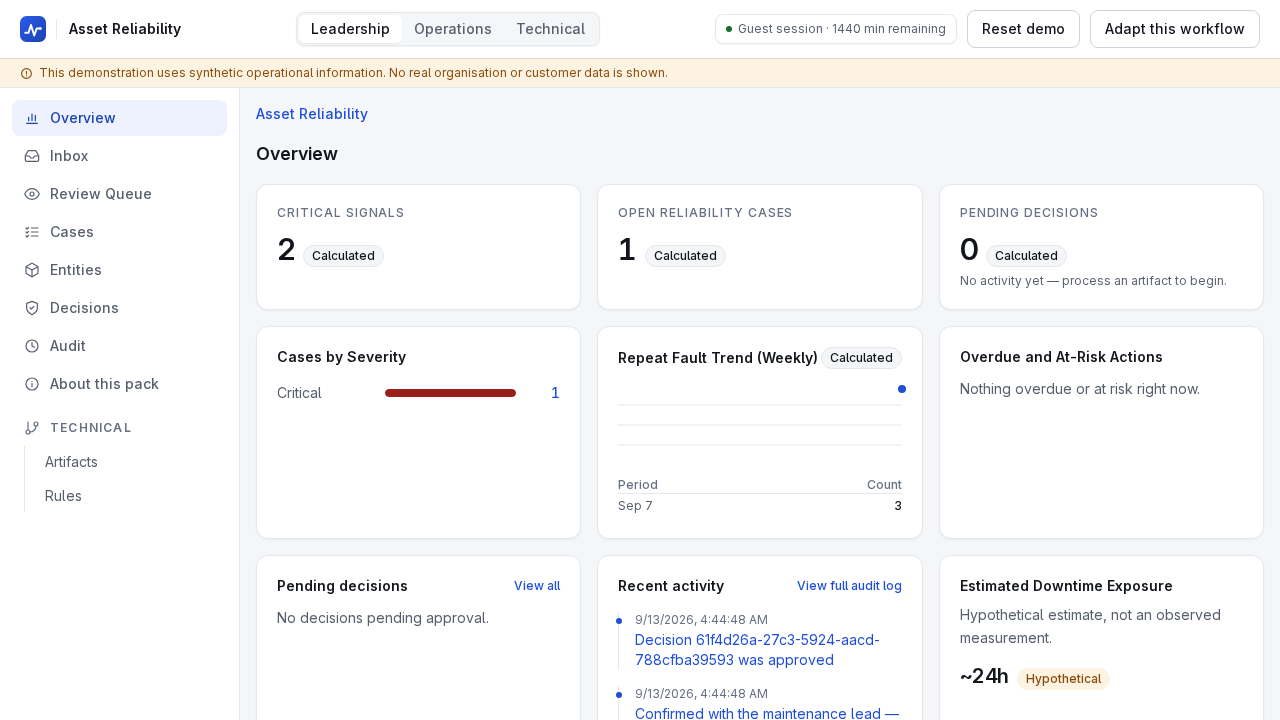
The Leadership dashboard after an approval: critical signals, open reliability cases, pending decisions, cases by severity, a repeat-fault trend and a downtime estimate labelled hypothetical rather than observed.

The pipeline

From a chat message to an approved decision, in nine steps

Follow one report through the system. Machines propose at the edges, a person decides at the two gates that matter, and the rest is recorded and enforced.

AI proposes A person decides The system records and enforces

Hover, focus or tap a step to read what it does. The packet stops if your system asks for reduced motion.

Walkthroughs

Watch it work before you install anything

A short trailer and one guided tour per scenario, recorded against the synthetic demo. Nothing plays until you press play, and captions are on by default.

Trailer · 25 seconds. The pipeline, one case, one approval.
Asset Reliability · a repeat brake fault, from chat message to removal from service.
Process Exceptions · a viscosity deviation that turns out to span two batches.
Document Assurance · a liability-cap conflict in a services agreement.

Three scenarios, one core

Same engine, different industries

Industry vocabulary, schemas, rules and workflows live in swappable Scenario Packs. The core has no industry logic in it, and a check in CI scans for that.

  • Asset Reliability

    A recurring brake fault on asset A-142 at a fictional distribution center, from an informal chat report to a safety-critical repeat occurrence.

    A person approvesremoving an asset from service

  • Process Exceptions

    A viscosity deviation on supplier lot KM-LOT-448 at a fictional processing plant, escalating across two batches into a cross-batch pattern.

    A person approvesholding the affected output

  • Document Assurance

    A liability-cap conflict in a fictional master services agreement, from contract execution to a formally proposed exception.

    A person approvesaccepting a tracked exception

Trust

How the AI is kept honest

These are screens from the running demo. Each one shows a control that stops a model’s guess from quietly becoming a fact.

Every claim cites its evidence, and uncertainty goes to a person

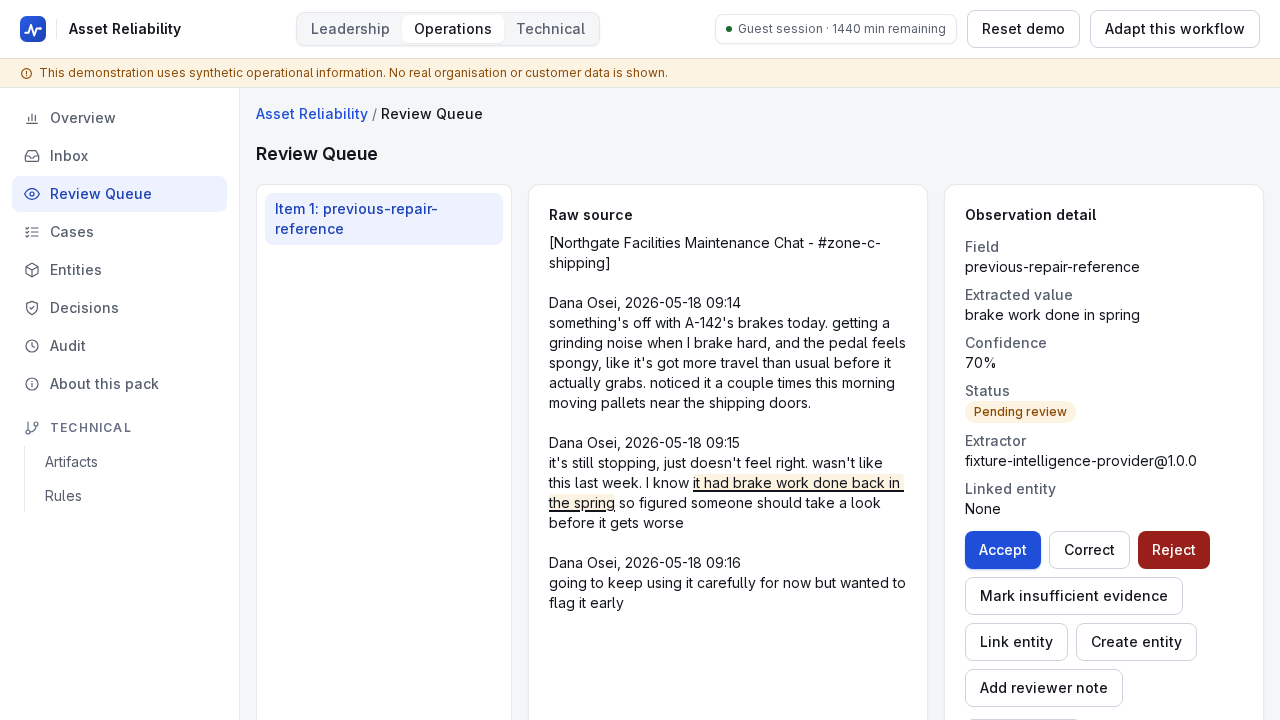
  • Evidence and confidence. Each extracted field keeps the exact source segment, the extractor’s identity and version, and a confidence. With no support, it says so instead of inventing a value.
  • Review queue. Low-confidence or ambiguous fields wait. The reviewer sees the raw source, the candidate value and the cited span, then accepts, corrects or rejects.
A review queue item showing the raw chat source with the evidence span underlined, the extracted value, a confidence of 70 percent, the extractor version, and Accept, Correct and Reject actions.

Rules are deterministic and show their working

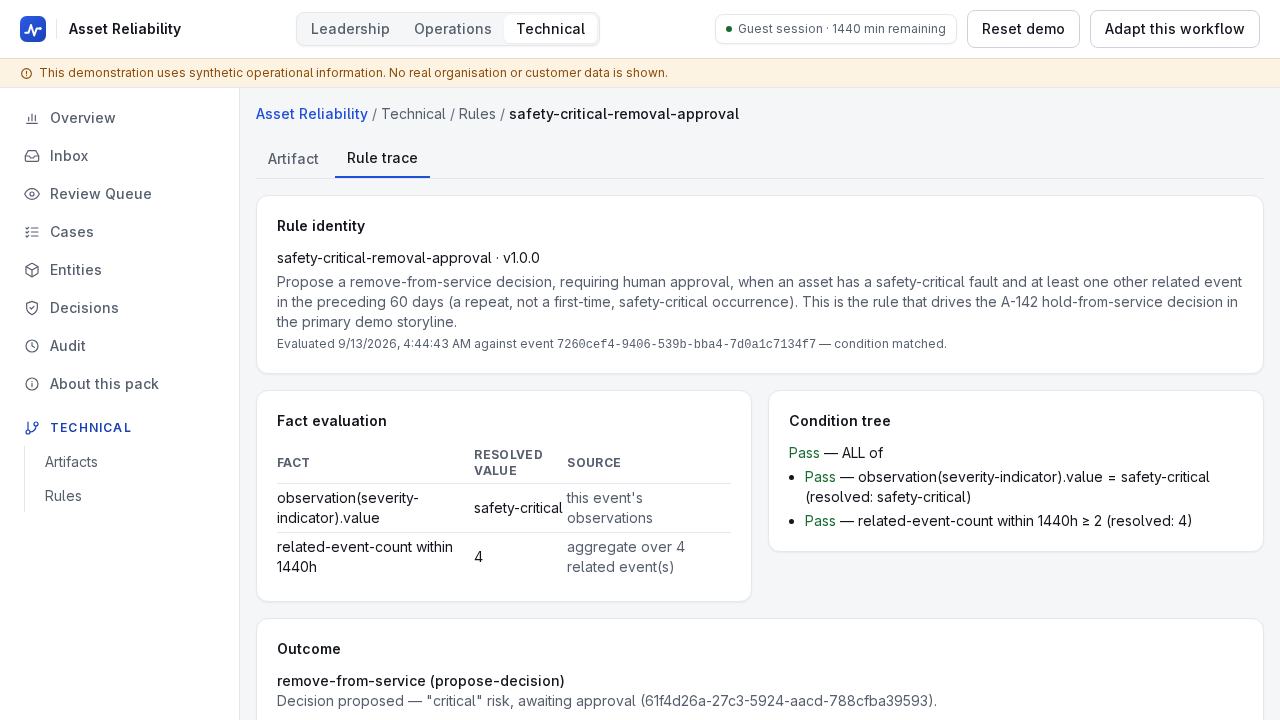
  • Closed fact catalogue. Rules cannot run arbitrary expressions. They read named facts the pack defines.
  • Visible trace. Every firing shows the facts it evaluated and the condition tree that matched, so a reviewer can see exactly why a case was opened.
The fact evaluation and passing condition tree behind a decision proposal.

Approval is a recorded human act

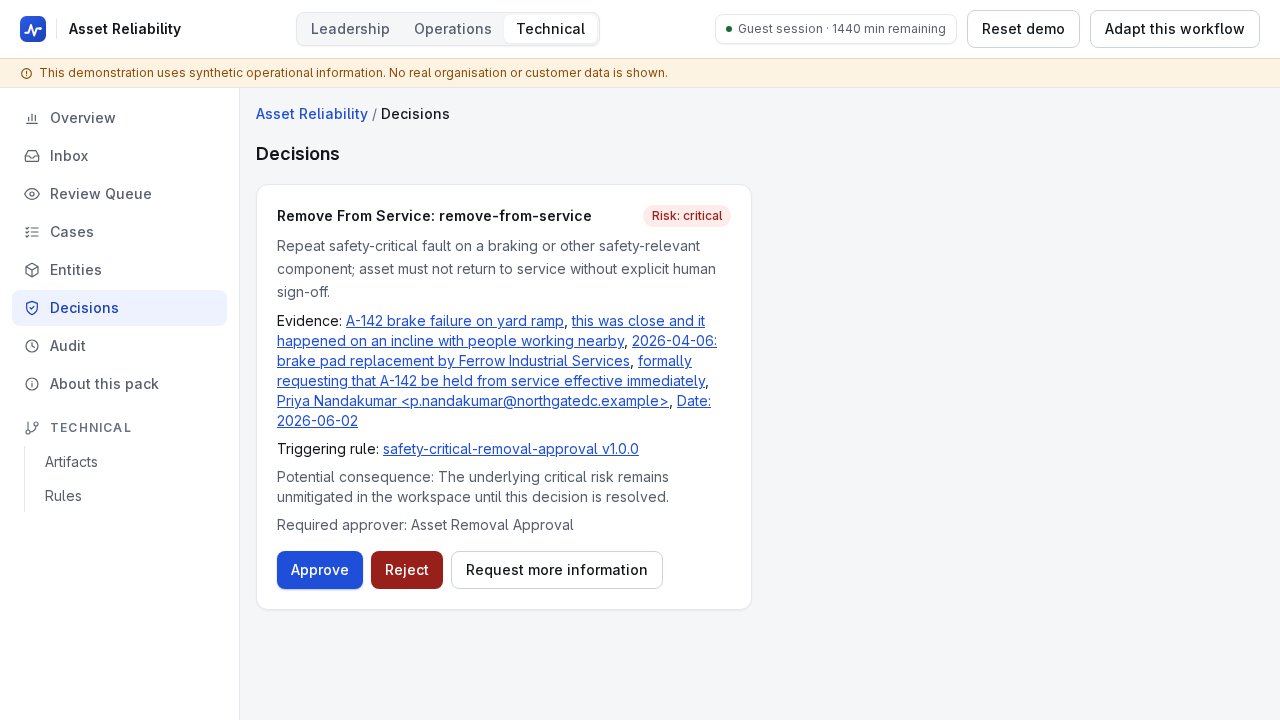
  • Proposals only. Providers and rules can propose a decision. They cannot approve, execute or change workflow state.
  • Enforced, then attacked. A high- or critical-risk decision cannot reach approved without a separate approval record. This is enforced in application code and the database, and tested with bypass, replay and injection attempts.
A critical-risk decision to remove an asset from service, with its evidence links, the triggering rule, the required approver role, and Approve, Reject and Request more information actions.

Everything lands in an audit trail

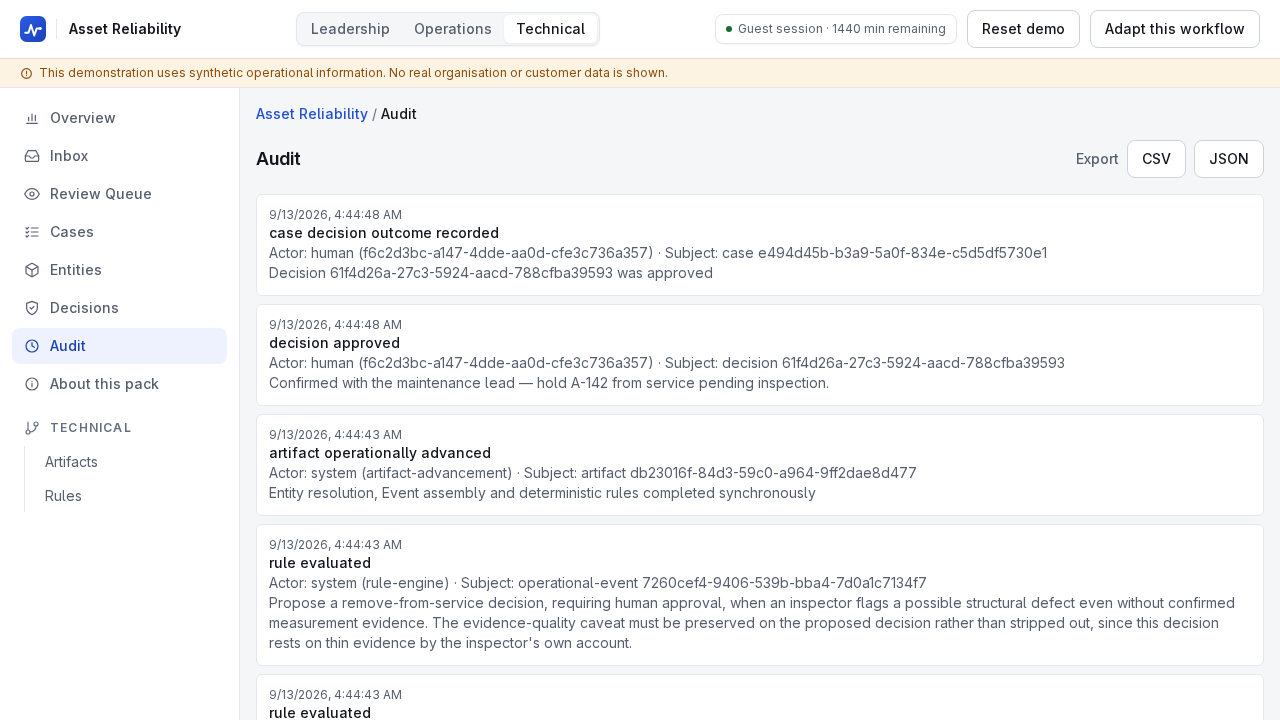
  • Append-only. Actor, subject, timestamp and causal links for each material step.
  • Corrections add, never rewrite. A correction appends a new entry and re-evaluates. History stays as it was.
The audit explorer listing decision approved, rule evaluated and case outcome entries, each with actor and subject, plus CSV and JSON export buttons.

No setup

Read one case from first message to approval

The evidence casebook follows a single synthetic case: the original reports, an uncertain extraction, scripted review, a deterministic rule, a proposed decision, a recorded approval and the work still open. The supporting files are embedded, so it reads offline.

Open the casebook

  • Original reports, quoted
  • Uncertain extraction and review
  • Rule trace and proposed decision
  • Recorded approval and remaining work
  • Checksummed supporting evidence

For agents and builders

Built to be read, tested against and extended

If you build agents or extractors, the repository gives you an index to read, tools to call and a corpus of awkward inputs to test against.

MCP server

Read-mostly tools over scenario packs, fixtures and an evidence casebook. stdio via npx after the package is published; --http serves streamable HTTP at /mcp and starts read-only. From a checkout, pnpm build then node packages/mcp-server/dist/cli.js is the same server.

{
  "mcpServers": {
    "oiw": {
      "command": "npx",
      "args": ["-y", "@oiw/mcp-server"]
    }
  }
}

Server README and client configs

Claude Code plugin

A pack-authoring skill that walks an agent through scaffold, author, validate and evaluate.

claude plugin marketplace add shekibahmed/operations-intelligence-workbench
claude plugin install oiw-pack-authoring@oiw

Author a pack

A new industry is a directory, not a fork. The guide documents the validator-enforced contract in authoring order, with a scaffold command and a template that already validates.

pnpm pack:scaffold my-pack --name "My Pack" \
  --description "What it covers"
pnpm validate:packs && pnpm eval --pack my-pack

Pack authoring guide

Adversarial fixture corpus

Every pack ships edge-case artifacts with gold outcomes: missing identifiers, conflicting dates, ambiguous references, negation, duplicates, and prompt-injection text hidden in chat, CSV, JSON and PDF content. Use them to test your own extractors.

Browse the edge cases
Run it

Four commands to your own copy

The guided tour creates an isolated, seeded guest workspace on first click. You need Node 22, pnpm 11 and Docker for the local Postgres.

Try the live demo

git clone https://github.com/shekibahmed/operations-intelligence-workbench.git
cd operations-intelligence-workbench
pnpm install && docker compose up -d && pnpm db:migrate
pnpm dev   # then open http://localhost:3000/demo